
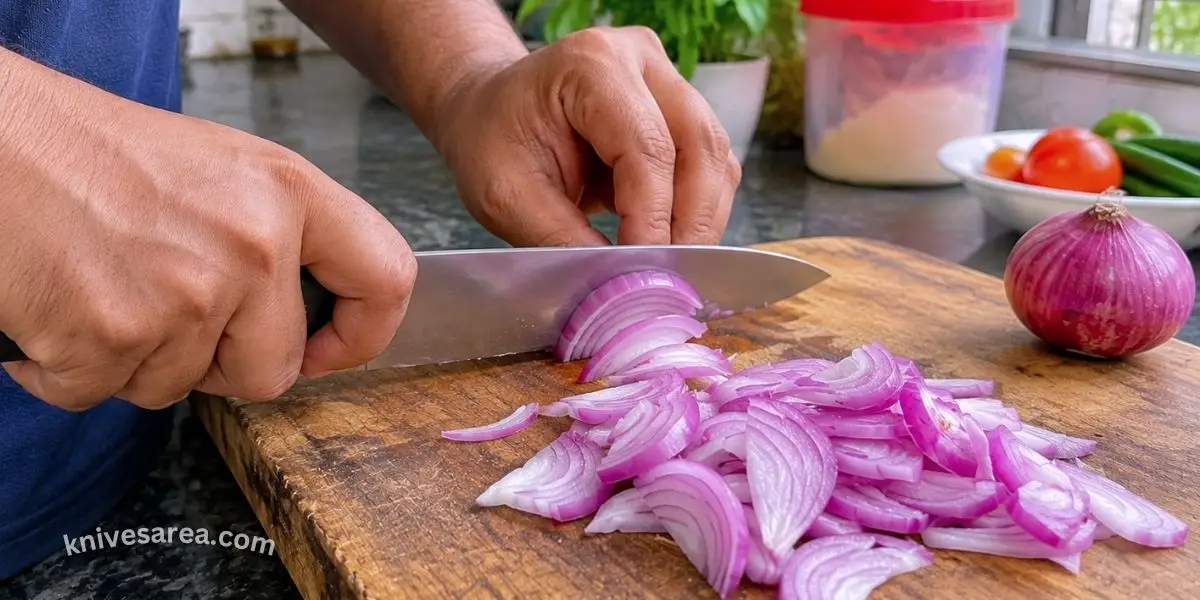
Learning how to dice an onion properly is one of the smartest skills you can learn. Nearly every savory meal begins with an onion sizzling in a pan. Yet this modest vegetable causes more kitchen frustration than just about anything. Thick chunks don’t cook while uneven pieces burn in the pan, ruining your dish. Worse, if you don’t have good knife skills, you’re in danger of chopping off your fingers. Once you have learned a simple, repeatable technique. Onion prepping is less than a minute and stress-free.
You do not need culinary school training or fancy gadgets. To get restaurant-quality results at home. You need a sharp blade, a sturdy cutting board, and the right method. Most home cooks make the mistake of chopping off the root end first. This causes the entire onion to fall apart on the board. Keep the root intact and make a series of three smart cuts. The onion holds itself together until the very last slice.
In this guide, I will walk you through the four-step method professional chefs use. You will also learn how to tell the difference between dicing, chopping, and slicing. Plus smart ways to store your prepped onions for busy weeknights.
What You Need Before You Start
A clean, organized prep station keeps you focused and prevents accidents before they start.
A Sharp Chef’s Knife: A dull knife will crush the cell walls of the onion rather than slicing through them neatly. This releases more eye-watering gases and makes the knife slide off the slick layers. Picking the Best Knife For Chopping Onions means you can take effortless control and prevent your wrists from getting tired.
Heavy Cutting Board: Wood or thick plastic boards are great. If your board slides around on the counter, place a damp paper towel or a silicone mat right underneath it. A steady board is non-negotiable for safe knife work.
A Scrap Bowl: Keep a small bowl next to your board for papery skins and stem ends. That way your workspace stays clean, so you don’t have to be brushing trash out of the way with a sharp blade in your hand.
Quick Safety Tip: Always use your non-dominant hand in a claw grip. Curl your fingers so that your knuckles are facing the blade, and gently place the flat side of the knife on your middle knuckle. This serves as a natural guide and keeps your fingertips safe from the sharp edge.
Chop vs. Dice vs. Slice: What’s the Difference?
Recipes throw around different cutting terms all the time, and using the wrong cut can change how fast your food cooks. Understanding how to dice an onion properly helps you follow recipes accurately, while knowing when to slice or chop gives you total flexibility in the kitchen.
| Feature | Dice | Chop | Slice |
| Shape & Size | Uniform cubes (usually 1/8″ to 1/2″ squares) cut cleanly. | Irregular pieces, varying slightly in size. | Long, thin crescent strips or full round rings |
| Precision Level | High – requires horizontal and vertical grid cuts. | Low—quick, informal cuts without strict measurement. | Medium — must be uniform in thickness throughout the curve. |
| Cooking behavior | Cooks at an even pace. Melts easily into sauces. | Unevenly cooks if pieces vary too much. Leaves some bite. | Melts slowly and caramelizes beautifully on low heat. |
| Top Dishes | Salsas, soups, omelets, fried rice, pasta sauces, meatloaf. | Stews in the slow cooker, roasting pans, stocks from scratch, stir-fries. | French onion soup, fajitas, burgers, and caramelized toppers. |
Step 1: Cut Off the Stem End (Top)
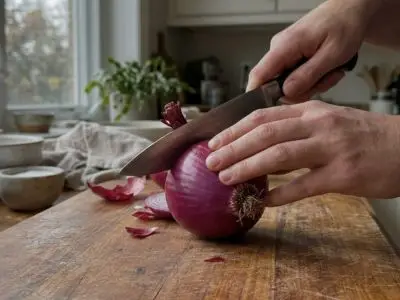
Take your whole onion and look at either end. One end has a dry, papery point sticking out. That’s the stem end. The other end is the root end, and it has little hairy fibers.
Lay the onion on its side on the cutting board. Grasp firmly with your claw grip and cut off about half an inch from the stem end. Don’t touch the root end. For the time being, leave the roots hairy.
Why is this so important? The root end is like a natural glue. It holds all the onion’s concentric layers together while you work. If the root is cut off at the beginning, the layers separate and slide. Taking the root off first means the layers immediately peel off and slide around, making your job twice as hard. After you cut off the top stem, you have a nice flat surface to work with.
Step 2: Cut the Onion in Half Through the Root
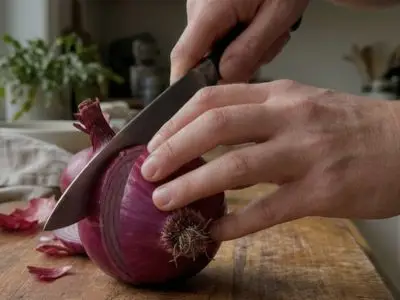
Stand the onion upright on the flat surface you created by cutting off the stem. Now, the hairy root end is pointing straight up at the ceiling. Having a flat base makes the onion rock-solid on the board so it cannot roll away under your knife.
Place the tip of your knife right in the center of the root end and slice straight down through the middle of the onion. You now have two halves, and each half still has half of the root holding its layers together.
Next, peel away the dry, papery outer skin from both halves. Sometimes the first fleshy layer underneath is tough, rubbery, or bruised. Feel free to peel that off too and toss it into your scrap bowl. You want crisp, firm onion layers to work with.
(Note: If you find yourself tearing up right about now. Check out my guide on How to Chop an Onion Without Crying for simple tricks that stop the sting before it starts.)
Step 3: Make Horizontal and Vertical Cuts
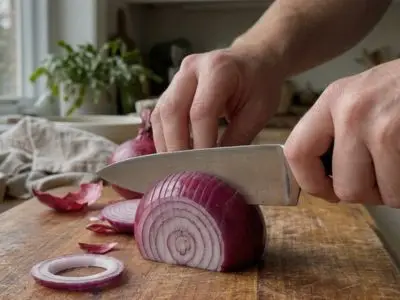
Lay one onion half flat-side down on your cutting board. Turn it so the hairy root end points away from your knife hand, and the open, cut stem end faces your blade. Knowing how to dice an onion properly comes down to building a grid inside the onion before making the final cuts.
The Horizontal Cuts
Place your non-dominant hand flat on top of the onion half to hold it steady. Keep your palm slightly arched so your fingers stay out of the way. Hold your knife blade parallel to the cutting board.
Carefully slice horizontally into the onion, starting from the stem end and moving toward the root. Stop about a quarter-inch to half-inch away from the root. Do not cut all the way through the root, or the onion will fall apart.
- For a medium dice, make one or two horizontal cuts spaced evenly apart.
- For a fine dice (great for salsas or sauces), make three closer horizontal cuts.
- If you have a small onion or want a rough dice, you can skip the horizontal cuts completely. The natural layers of the onion already create horizontal lines on their own.
The Vertical Cuts
Once your horizontal cuts are done, keep the onion half in the exact same position. Switch back to your claw grip on top of the onion.
Point the tip of your knife toward the root end. Cut vertically from the top of the onion down towards, but not quite reaching, the base.
Ensure the distance between cuts matches the required dice size. For small dice, make the cuts 1/4″apart, and for a standard medium dice, 1/2″. As the onion tapers on the sides, slightly angle the blade at the outside of the cut so the side pieces meet the centre pieces. Cut vertically again, but this time from the stalk end to before the root end.
Depending on the size of dice you want, space these slices accordingly. For a fine dice, space slices by 1/4″. For a medium dice, space slices by 1/2″. As the onion tapers slightly along the sides, angle the blade in towards the outside. That the dice on the edges match the size of those in the centre.
Step 4: Slice Across to Create Even Dices
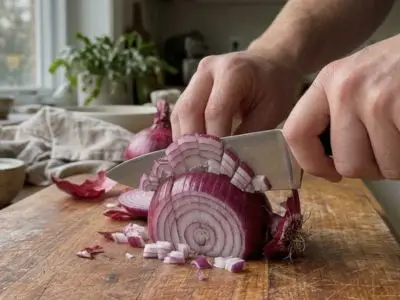
Keep the onion half flat on your cutting board and turn it slightly so you can cut across your vertical slices. Tuck the fingers of your guiding hand into a “claw” shape to keep your fingertips safe.
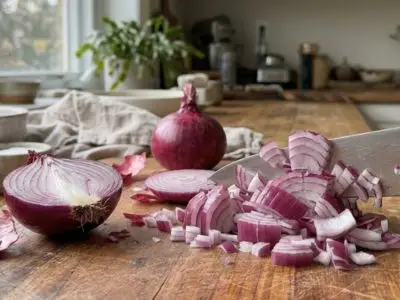
Start at the open stalk end and slice straight across toward the root. Push the blade forward in a smooth, rocking motion. Even cubes should fall neatly onto your board. Keep the spacing consistent until you reach the firm root end.
Once you reach the root, you will have a small piece left over. Lay it flat on the board and trim around the hairy center of the root so you don’t waste any good onion. Repeat this exact process with the other half. After dicing a few onions, you will find a natural rhythm—and you’ll be chopping through bags of them in no time.
Common Mistakes That Ruin Your Dice
Even when you know how to dice an onion properly, a few sneaky habits can slow you down or give you messy results. Watch out for these common pitfalls next time you step up to the cutting board.
1. Sawing Back and Forth
A sharp knife should glide through an onion with a smooth forward push or gentle rocking motion. If you find yourself sawing back and forth like you are cutting a loaf of bread, your blade is dull. Honing your knife on a ceramic honing steel before every prep session keeps the edge aligned and makes it easier to use.
2. Cutting All the Way Through the Root
We talked about this in Step 1, yet it remains the number one mistake in home kitchens. Every time you slice through the root too early, the onion splays out flat like a deck of cards. Always leave that half-inch safety buffer at the root end until the very end.
3. Using a Tiny Paring Knife
Many people reach for a small paring knife because it feels less intimidating than a big blade. In reality, a small blade gets stuck inside large onions, forcing you to push harder and lose control. An 8-inch chef’s knife has the length and weight to glide cleanly through the entire bulb in single strokes.
4. Crowding the Cutting Board
When a big pile of diced onions builds up right under your blade, it blocks your view and makes the board slippery. Scrape your finished dices into a prep bowl after finishing the first half of the onion so you have a clean, open surface for the second half.
Frequently Asked Questions
Can I chop onions in advance?
Yes, chopping onions ahead of time saves tons of effort during a busy week. Dice a big batch on Sunday so they are ready for your meals all week long. Store them in an airtight glass jar. Avoid plastic containers, as they absorb strong onion odors permanently.
How long can I store chopped onions?
Chopped onions stay fresh in the fridge for 7 to 10 days. Seal them in an airtight glass container or a zip-top bag with all the air squeezed out. This keeps the sharp smell from spreading to your milk, butter, or fruit. If the onions feel slimy or smell sour, toss them out.
You can also freeze chopped onions for up to 6 months. Just keep in mind that they turn soft after thawing. So use them in cooked dishes rather than green salads.
What is the best knife to chop onions with?
For the best results, use an 8-inch chef’s knife or a 7-inch Santoku knife. These blades are wide, letting you rest your knuckles safely against the side as you cut.
Final Thoughts
Once you master how to dice an onion properly, meal prep becomes so much faster! Leave the root intact, make simple grid-like cuts, and keep your fingers tucked into a safe claw grip. Follow these basics, and you will get perfect onion cubes every single time.
Take it slow with your first few hang-ups on how to dice an onion properly with a sharp knife. Soon, you’ll prep dinner twice as fast—and you will never dread recipes that call for onions again.