
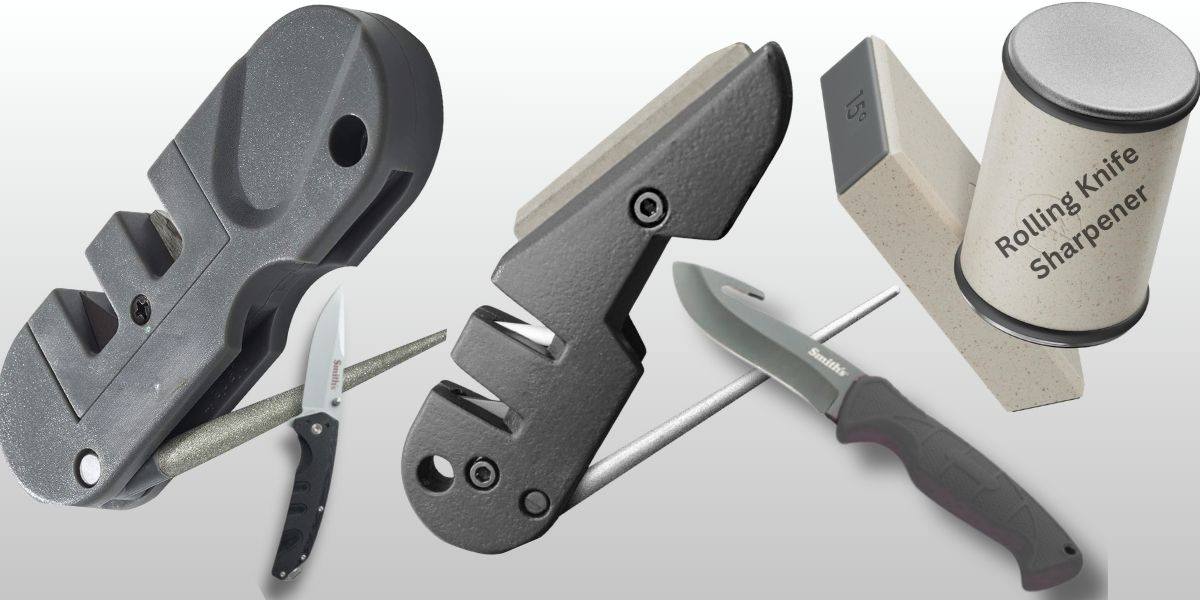
Finding the best hunting knife sharpener is key. In the field, a dull blade is more than a pain. It can be unsafe. It can also spoil a hunt. If you are deep in the woods and need to dress an elk or gut a deer, your knife must be sharp and ready to use.
Many hunting knives use hard steels. These include S30V, 1095 carbon steel, and MagnaCut. A basic kitchen sharpener may not work well on these steels.
We spent over 45 hours testing 14 top hunting knife sharpeners. Used them in real field tests, including skinning tasks using the best deer gutting knife. We cut sisal rope and made feather sticks from hardwood. Checked how well each tool sharpened a blade. We also checked how long the edge stayed sharp, how easy each tool was to carry, and how easy it was to use without a workbench.
IN THIS ARTICLE ————————————
- Best Picks List → How Tested These Sharpeners → FAQs →Final Thoughts
- Our Favorite Field-Tested 14 Hunting Knife Sharpener Setups
- Buyer’s Guide – How to Choose a Hunting Knife Sharpener
- How to Sharpen a Hunting Knife (Step-by-Step)
Our Favorite Hunting Knife Sharpener Combos (Field-Tested)
| Sharpener Combo | Read Review | Best For | Key Advantage |
| Combo A: 1. Smith’s PP1 Pocket Pal Sharpener & 2. Diamond Combo Sharpener | Jump to Review ↓ | Ultra-lightweight backpacking & multi-stage edge maintenance | Features a round diamond rod for serrations and gut hooks |
| Combo B: 1. Professional System Sharpener & 2. Lansky 4-in-1 Sharpener | Jump to Review ↓ | Absolute edge precision at home & quick trailside touch-ups | Controlled multi-angle guide clamp guarantees a perfect bevel |
| Combo C: 1. Lansky Ceramic Rod Sharpener & 2. Diamond Sharpener 2-Piece | Jump to Review ↓ | Beginners wanting mistake-free vertical rod sharpening | Pre-drilled wooden base stores all 4 premium ceramic rods |
| Combo D: 1. Fino Edge Sharpener & 2. AccuSharp Strong Carbide Sharpener | Jump to Review ↓ | Budget-conscious hunters seeking rapid workshop grinding | Built-in full-finger guard protects hands from accidental slips |
| Combo E: 1. Dual Whetstone Sharpener & 2. Work Sharp Benchstone | Jump to Review ↓ | Professional knife owners demanding 100% manual control | Pivot Response system mimics the natural curve of your blade |
| Combo F: 1. Smith’s CCKS 2-Step Sharpener & 2. Work Sharp Field | Jump to Review ↓ | Complete off-grid hunting trips & long-distance backcountry survival | Floating pocket chassis paired with a built-in leather strop |
| Combo G: 1. Smith’s Adjustable Sharpener & 2. Work Sharp Portable | Jump to Review ↓ | Managing a diverse knife collection with varied factory angles | Mechanical dial adjusts sharpening angles from 14° to 24° |
How Tested These Sharpeners
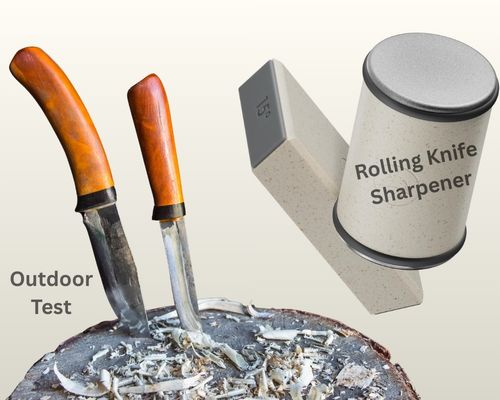
Check Price on Amazon: Rolling Knife Sharpener
We tested each sharpener the same way. Followed the same steps every time. This kept the test fair.
- Setting a Baseline: Used a carbon steel hunting knife. Carbon steel gets very sharp. It also dulls fast. This helps us see clear results. Before each test, we dulled the knife on steel. Then use only one sharpener. Sharpened the blade to shaving sharp. This step showed how fast the sharpener worked. It showed how fast it removed metal.
- Rope Cutting Test: after this, the sharp blade test on the rope using sisal rope. Sisal rope is rough and dulls blades fast. Made ten slow cuts and checked each cut. Was it clean or rough? Did it need force? This test shows real use.
- Edge Retention Test: Checked the edge again, after ten cuts. Did simple tests. Fast touched the edge of a nail, shaved arm hair. Also used a small edge tester. This test showed how long the edge stayed sharp. Some edges feel sharp at first. But they dull fast. Recorded how much sharpness.
- Outdoor Test: Next, we went outside. Sharpened the pocket knife again. Then use it for camp tasks. Feather sticks: made from thin wood curls. This shows a fine edge. Batoning: split small wood pieces. This tests edge strength. Camp cuts: cut small branches and plastic ties. Also checked ease of use. Was the sharpener easy to hold? Was it small enough for a pack? Could we use it without a bench?
- Control and Repeat: To place the test fair, reset the knife each time. Use a trusted bench stone. This gave the same starting edge. Repeat the full test three times per sharpener. This reduced mistakes.
How Scored Each Sharpener
- Scored four main areas: Sharpening Speed, how fast it sharpens? Ease of Use: Was it simple and safe? Edge quality: How sharp was the edge? Did it last? Portability is it best for the home or the field?
- We used real data and real use. This helped us build a clear profile. Now can choose the right sharpener with confidence.
Here is our Review of 14 Hunting Knife Sharpeners that have been tested in the Field:
Smith’s PP1 Multi-tool and Diamond Combo Sharpener
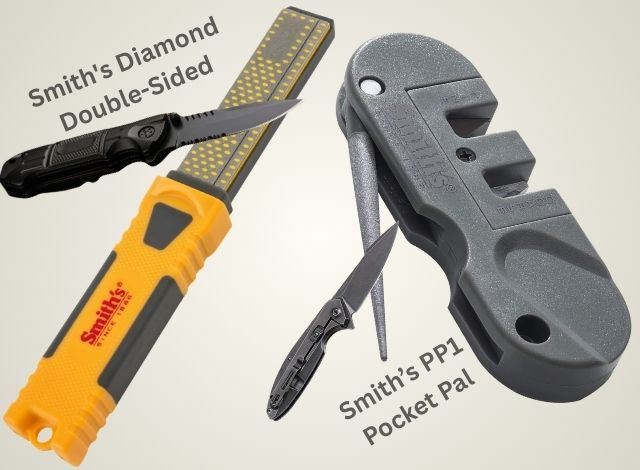
Smith’s is now a leader in knife and scissor sharpeners. If you want a versatile setup that handles both off-grid survival and heavy-duty grinding in your workshop. The Smith’s PP1 Pocket Pal and 4-inch diamond combination sharpener are our top recommendation. This combo perfectly balances ultra-portable trailside touch-ups with serious bevel restoration. For serious outdoorsmen, it is simply the best overall hunting knife sharpener setup you can get.
Part A: Smith’s PP1 Pocket Pal Pocket Sharpener
We took this little tool out on a multi-day backcountry trek, and it quickly became a favorite. It feels practically weightless in your pocket. When we needed a quick edge after dressing a deer, it delivered without making us unpack a whole kit.
The PP1 is incredibly lightweight, sliding right into your hunting vest. It features pre-set carbide blades for a quick edge on dull blades. Plus ceramic rods for finishing. This tool is 3.5 inches long, 1 inch wide, 0.01 inches high, and weighs just 0.02 pounds. This means it slides right into your hunting vest without adding any bulk. It works incredibly well for hunting knives.
- Pros: Ultra-lightweight; includes a fold-out diamond rod for gut hooks.
- Cons: Not meant for major edge profiling or severely damaged blades.
Part B: Smith’s 4-Inch Diamond Combination Sharpener
Back at the basecamp workshop, we put this bench stone to work on a badly chipped fixed blade. The rough side cuts through steel quickly, while the smooth side polishes the edge. It stays tight on the table so you don’t have to worry about it moving
When you get back to your camp or your workshop, this bench stone takes over. It has a diamond surface for making a new angle and a smooth diamond surface for getting a sharp edge. This helps you pick the right grit instantly. I find the tool powerful yet still very compact. The tool measures 9 inches long, 2 inches wide, and 1 inch high. The tool weighs 0.05 pounds.
- Pros: The tool uses two grits for sharpening. The tool has a base that keeps the work area safe.
- Cons: The tool is a bit too heavy and bulky to carry in a minimalist survival pack.
Professional System Sharpener & Lansky 4-in-1 Sharpener Combo: Best Premium Sharpener
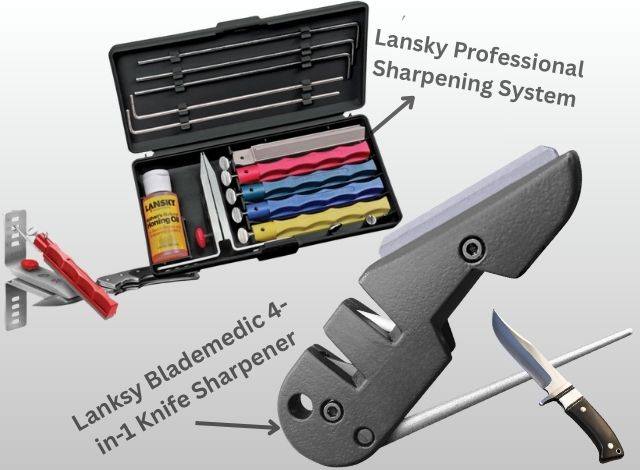
If you want a perfectly sharp edge at home but still need a quick touch-up tool for the trail, this combo is your best bet. These two Lansky tools work great together. They keep your favorite knives razor-sharp and ready to go.
Part A: Lansky Professional Sharpening System
The Lansky Professional System is incredibly easy to use. Its biggest advantage is the way it holds your knife. The clamp keeps the blade perfectly steady. This gives you a clean, precise edge every single time. You can choose from different sharpening angles. The best part is that the angle stays the same with every stroke. This makes the whole process smooth and mistake-free for a hunting knife.
- Size: 10.25 inches long x 9.75 inches wide x 1.5 inches high.
- Weight: 1.1 pounds.
- Grit Grade: The sharpener has four grades—coarse, medium, fine, and ultra-fine.
Pros: Perfect bevel tool, great flatness, and Guided Angle Rods. Four grit stages cover everything from rough profiling to mirror polishing.
Cons: Setting up the clamp and rods takes a little time and practice at first.
Part B: Lansky 4-in-1 Knife Sharpener
Now let’s look at the second part of this setup. This is a pocket-sized 4-in-1 tool that sharpens your knife in four different ways. It features a tungsten carbide slot. Use this to repair damaged or very dull pocket knife edges. This little tool slides right into your pocket. You don’t need to carry heavy bench stones into the woods because this slides right into your vest pocket without you even feeling it.
- Size: This tool is 3.25 inches long, 1.77 inches wide, and 1.48 inches high.
- Weight: 3.53 ounces
- Grit grades: You get a nice mix of medium and coarse grit grades built right in.
Pros: Lightweight and fits tools easily in your pocket. No assembly or complex setup required for quick field touch-ups. Multi-functional design works with straight, serrated, and gut-hook edges.
Cons: Can’t customize preset angles for unique knife profiles. It is not meant for heavy edge profiling or fixing badly chipped blades.
Lansky Ceramic Rod & 2-Piece Diamond Sharpener Combo: Best Outdoor Sharpener
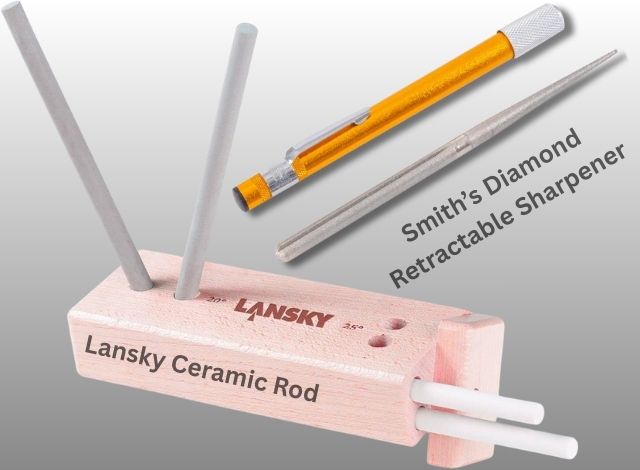
It pairs mistake-free vertical rod sharpening with a highly portable pocket diamond rod. Together, they handle everything from quick touch-ups at home to fast edge maintenance out in the field. Together, they handle everything from touch-ups at home to quick edge maintenance in the field.
Part A: Lansky Ceramic Rod Sharpener
Many people find it hard to maintain a consistent angle on a flat stone. But this sharpener makes the entire process incredibly easy. All you have to do is set your desired pre-drilled angle and move the knife straight down the rod. The blade catches a sharp edge remarkably fast.
- This 2-stage knife sharpener features a sturdy wooden base.
- The base stores the rods inside.
- It comes with four 5-inch ceramic rods.
- Two rods are medium 800-grit. Two rods are fine 1000-grit.
Pros: It’s super compact to toss in a bag. Cuts an edge remarkably fast and doesn’t require any messy oils or maintenance.
Cons: Too slow and inefficient for heavily damaged or completely blunt blades.
Part B: 2-Piece Diamond Sharpener
The other half of this setup is sleek. It’s a pen-style diamond rod knife sharpener for hunting knives that feels weightless and sits comfortably in your hand. Can use it on ceramic knives and steel knives. The diamond rod sharpens dull edges. The groove helps sharpen hooks and pointed tools. The rod has a strong diamond coating.
- Get two sharpeners in one pack. Each one is about 5.5 inches long.
- You can pull it out to 9 inches when in use. An aluminum cap covers and protects the rod. When you’re not using it. The whole tool feels solid and lasts for ages. The fine grit ensures smooth, easy sharpening.
- It also keeps fingers safe.
Pros: The pen-style design slides cleanly into your pocket or hunting vest without adding any bulk. It features a dedicated groove specifically for sharpening gut hooks and fish hooks.
Cons: The narrow rod surface is not ideal for larger fixed-blade hunting knives. The fine grit is built for touch-ups rather than resetting a factory bevel.
Fino Edge & AccuSharp Strong Carbide Sharpener: Best Budget Hunting Knife Sharpener
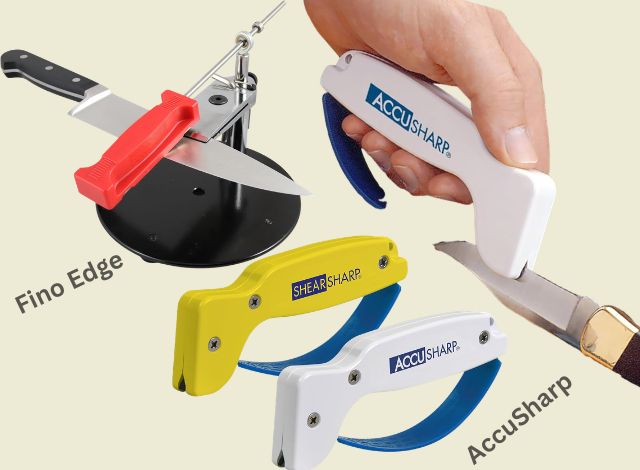
If you want a reliable setup that gets your blades razor-sharp without breaking the bank, this budget combo is a fantastic choice. These two tools deliver serious value for the money. They make it incredibly easy to keep your kitchen and outdoor knives ready for action.
Part A: Fino Edge Knife Sharpener
The Fino Edge is a strong, straightforward sharpener that gets the job done without any fuss. It uses diamond stones. These stones sharpen fast. Get a razor-sharp edge in less time. This kit works for most knives. Can use it for kitchen and outdoor knives. It helps find the right angle. The secret lies in its fast-acting diamond stones.
- Made of alloy steel.
- It comes in black, red, and silver.
- It weighs 3.5 pounds.
- It has three grit levels. Can sharpen step by step. Start coarse. Then use fine.
Pros: Heavy build keeps the sharpener from slipping. Sharpens blades fast without wasting time. Solid workshop sharpener results on a budget.
Cons: The 3.5-pound sharpener frame belongs on a workbench. Not in a backpack. Clamping the knife straight takes a bit of practice.
Part B: AccuSharp Strong Carbide Sharpener
Now let’s look at the second tool in this budget combo. The AccuSharp is a legendary little handheld tool that can put a sharp edge on a blade in about 10 seconds. When you are busy working, a fast touch-up tool keeps you moving. It uses tough tungsten carbide blades to restore the edge. A clean edge in just a few quick strokes, requiring almost no effort.
- 9 inches long, 4 inches wide, 1 inch high.
- Material plastic.
- Weight: 0.2 pounds.
- Coarse-grit sharpener.
Pros: 0.2-pound sharpener, making it perfect for your hunting vest. The full-finger guard protects you from accidental slips.
Cons: The aggressive carbide blades remove metal quickly. So it shouldn’t be used every day on expensive custom steel.
Whetstone & Work Sharp Benchstone Combo: Best Field Knife Sharpener

If you want a setup that works for both manual control and quick guided sharpening, this setup will suit you. At your camp, I find a simple whetstone paired with a multi‑sided benchstone is the choice for sharpening. These tools let you fully sharpen edges or create a finish with the whetstone and benchstone.
Part A: Sharp Pebble Dual Whetstone
This dual-grit stone from Sharp Pebble works fast. On kitchen cutlery, hunting blades, and pocket knives alike. It features two different sides. The whetstone is made from tough silicon carbide. It is built to last through heavy sharpening sessions.
- The grit type is coarse. The brand is Sharp Pebble.
- The kit includes a 400/1000 dual-grit whetstone.
- One side is 1000 grit for fine sharpening.
- The other side is 320 grit for rough work.
Pros: I think the side design is useful because it means you don’t have to carry two blocks. I like the bamboo base because it keeps the stone still which is safer. The silicon carbide material cuts through steel fast. Doesn’t change its flat shape.
Cons: I have to wait because letting the stone sit in water takes time before I can begin using it. I need to be careful and practice to keep the angle when I use it by hand.
Part B: Work Sharp Guided Benchstone
The Work Sharp Benchstone is a fantastic piece of gear. It features three different sharpening surfaces in one unit. The most impressive feature is the Pivot Response system. The stone actually moves and follows the natural curve of your knife blade as you stroke. Keeping your edge perfectly uniform from heel to tip.
You can lock the pivot system in place if you prefer a completely firm, traditional sharpening surface. The unit sits tight on any flat surface.
- It packs a 400-grit coarse diamond plate
- An 800-grit fine diamond plate and a fine ceramic stone.
- It features built-in angle guides that can be set precisely to 20° or 25°.
- The angle guides can be removed instantly if you prefer to sharpen by hand.
The coarse and fine components are highly efficient, weighing only 2.4 ounces for the individual stone parts.
Pros: Three-sided rotation lets you switch from coarse diamond to fine ceramic in seconds. Pivoting stone action automatically matches the sweep of curved hunting blades.
Cons: The multi-component plastic frame is slightly bulky for minimalist field packs.
Smith’s CCKS 2-Step & Work Sharp Field Sharpener Combo: Best Portable Sharpener for Outdoors
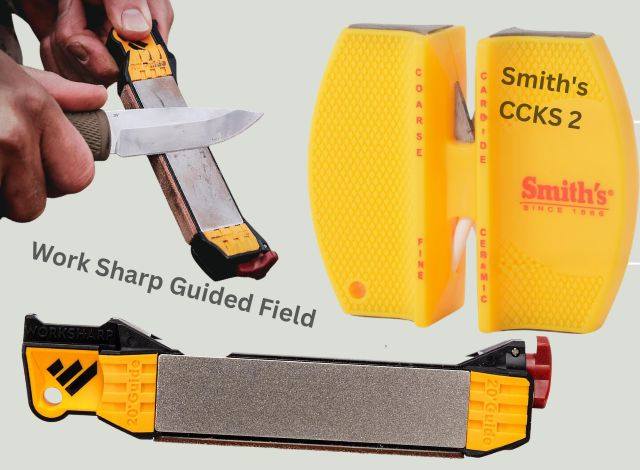
If you want a sharp edge deep in the woods, carrying heavy bench stones is not an option. You need something lightweight, compact and versatile so that you can clean up a blade right after heavy camp chores. This combo is a lightweight pocket companion and a comprehensive manual sharpening system. They work beautifully as a team. Making them the ultimate off-grid setup for backpacking and survival trips.
Part A: Smith’s CCKS 2-Step Knife Sharpener
The Smith’s CCKS 2-Step is incredibly simple. You can throw it into any pack. This sharpener works on all knives. It is great for fillet knives. The ceramic rods smooth the edge. They keep knives razor-sharp. The carbide slot fixes very dull blades. Pull the knife through 3 or 4 times. The edge will come back fast. The angles are set for you. Get steady results every time. The sharpener is great for hunting, fishing, and outdoor trips. It even floats on water. It has non-slip rubber feet for safety. The sharpener is small and light.
- It has two grit types, coarse and fine.
- The coarse side sharpens dull blades.
- The fine side smooths the edge.
- Weighs less than two ounces.
- The item measures 2.33 by 2.71 inches.
Pros: It weighs than 2 ounces and slips easily into a shirt pocket. The pre-set angles mean there is never a need to guess the position. The buoyant chassis floats on water, making it great, for fishing.
Cons: The carbide side cuts metal fast and can wear down blades if the carbide side is overused.
Part B: Work Sharp Guided Field Sharpener
Now let’s look at the second part of this outdoor setup. The tool includes coarse and fine diamond plates that attach magnetically and lift off easily, making sharpening much faster in the field. It also features a rotating ceramic rod with coarse, fine, and fish hook sides, as well as a real leather strop to pull off that final, hair-shaving edge.
- It offers 20° and 25° angle guides.
- With a 3-year warranty.
- Size: 9.53 x 5.42 x 1.12 inches.
- Weight: 135 grams.
- Grit: coarse and fine.
Pros: This sharpener includes diamond plates. With a rotating rod and a leather strop all in one unit. The ramped angle guides help keep the edge flat. The removable plates have hidden spaces for gear or instructions.
Cons: Switching between the diamond plates, the ceramic rod, and the leather strop takes time to master. You need practice to find a rhythm. When moving from one step to the next.
Smiths Adjustable & Work Sharp Portable Combo: Diamond Sharpener for Hunting Blade
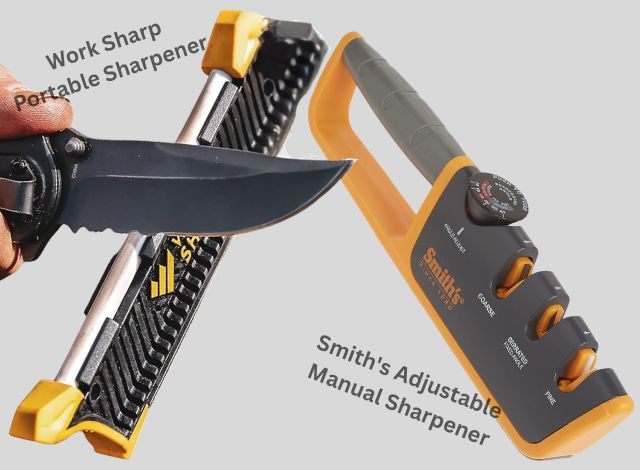
When you are managing a diverse collection of knives. A single fixed-angle sharpener just won’t cut it. Your thin fillet knife requires a completely different edge than a thick, heavy-duty camp cleaver. This combo brings together an adjustable manual bench tool and a slim, pocket-sized field rod. Together, they create a versatile setup that can handle almost any blade shape or factory angle you throw at it.
Part A: Smith’s Adjustable Manual Knife Sharpener
The Smith’s Adjustable sharpener is a game-changer if you hate guessing factory angles. While prepping meals at the camp table, we used this to touch up both a delicate paring knife and a rugged survival blade.
It works well on many knife types. The sharpener uses coarse and extra-fine grit. This helps repair and polish the edge. The sharpener has an easy-change dial. You can set the angle quickly. It supports six angle settings. The range goes from 14° to 24° per side. This helps match many knife styles. Abrasive parts are replaceable.
- 10.75 inches long, 2.5 inches wide, and 1.19 inches high.
- Weight: 0.5 pounds.
- Coarse and fine grit.
- It comes in gray and yellow.
- The handle has a soft grip. The base has non-slip rubber feet. This keeps the sharpener steady while you work.
Pros: Mechanical dial switches between six angle settings instantly. Coarse slot aggressively repairs deeply worn edges.
Cons: Frame takes up noticeable space in a compact pack.
Part B: Work Sharp Portable Hunting Knife Sharpener
When you are tracking through the woods and need a quick, no-nonsense touch-up, the Work Sharp Portable takes over. This slim little tool lived in a side pocket of our pack the entire trip. And we completely forgot it was there until our everyday carry knife started struggling with basic cuts. It requires absolutely zero assembly or setup time. You get a built-in 20° angle guide on the diamond plate for fast sharpening.
- Sharpener Size: 1.75 inches long, 0.5 inches wide, and 6.5 inches high.
- Weight: 1.6 Ounces
- Fine-grit and ceramic material Sharpener.
Pros: Zero setup needed for quick field touch-ups. Ramped guides make it easy to maintain a steady stroke.
Cons: The fine ceramic setup is meant for touch-ups, not heavy grinding.
Buyer’s Guide – How to Choose a Hunting Knife Sharpener

A sharp hunting knife is very important. It keeps you safe in the field. It also helps you work faster. A sharp knife cuts clean and smoothly. You do not need much force. A dull knife is risky. It slips more and can cause injury. This guide will help you choose the right knife sharpener. The best sharpener depends on three things:
- Where will you use it
- Your skill level
- Your budget
Below is a quick guide to the main types of hunting knife sharpeners.
| Types of Knife Sharpeners | Best For | Benefits |
| Guided Field Sharpeners | Hunters who need a full tool in the field. | Small and easy to carry. Many tools in one sharpener. Often includes diamond plates, ceramic rods, and a strop. Built-in guides help keep the same angle |
| Pocket Pull-Through Sharpeners | Quick sharpening in the field. | Very small and light. Very easy to use. Great for quick touch-ups. Usually very low cost |
| Sharpening Stones (Whetstones) | Users who want full control. | Gives great control of the blade edge. It can make a very sharp edge. Works with many knife types. |
| Guided Angle Systems | Home users who want very exact results. | Holds the knife at the same angle. Makes sharp results each time. Great for premium steel knives. |
| Electric Sharpeners | Fast sharpening at home. | Very fast sharpening, Easy to use. Good for very dull knives, needs little effort. |
Key Things to Check Before You Buy a Hunting Knife Sharpener
Before you buy a sharpener, think about a few simple things. These tips help you pick the right tool. Where Will You Sharpen Your Knife? This is a very important question. Will you sharpen your knife in the field or at home?
- In the Field: Need a small and light sharpener. It should fit in your pack. Pocket sharpeners work well in the field. Guided field sharpeners are also a good choice. Pick one with an angle guide. The guide helps you keep the right angle.
- At Home or in a Workshop: At home have more options. Use a guided sharpening system. Can also use whetstones. Some people prefer electric sharpeners because they are fast.
What Steel Is Your Knife Made Of?
Many modern hunting knives use strong steel. Examples include S30V, 20CV, and MagnaCut. These steels remain sharp for an extended period. But they are hard to sharpen.
- Hard Steel: Hard steel needs a diamond sharpener. Diamond is very strong. It can cut hard steel well. Normal stones may struggle with these steels. They may not make a very sharp edge.
- Soft Steel: Soft steel is easier to sharpen. Use ceramic stones. Also, use normal whetstones. Carbide sharpeners can work too. But they are not the best choice.
What Edge Angle Do You Need?
The edge angle affects sharpness and strength. Most hunting knives use an angle of 17° to 25° per side.
- Lower Angle 17° to 20°. This angle is very sharp. It works better for skinning and fine cuts.
- High-Level Angle 20° to 25°. This angle is powerful. It works fine for tough tasks. For example, cutting bone or thick meat. A sharpener with a 20° guide is a safe choice.
What Is Your Skill Level? Your skill level also matters.
- Beginners: New users should pick a sharpener with angle guides. The Work Sharp Guided Field Sharpener is a good example. It helps you keep the right angle. This makes sharpening easy and safe.
- Expert Users: Skilled users may prefer extra control. Some use advanced guided systems for fine precision.
A Warning: Avoid Carbide Pull-Through Sharpeners
Many cheap pull-through sharpeners use carbide blades. We are against using them on good hunting knives. These tools remove metal very fast. Make the edge weak and rough. It may also chip the blade. Carbide sharpeners can also wear down a knife fast. This can shorten a knife’s life. May use them for cheap knives or axes. But they are not good for quality hunting knives. For a good hunting knife, use a diamond or ceramic sharpener. These tools grind the metal bit to a level. They help make a strong, sharp-edged blade. Hope this guide helps pick the right sharpener.
How to Sharpen a Hunting Knife (Step-by-Step)
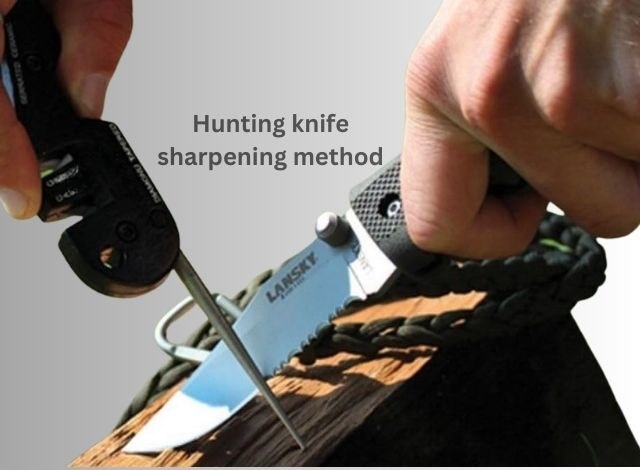
A sharp hunting knife cuts fast and on the spot. A dull knife slips and can cause harm. Use these easy steps to sharpen a knife.
What You Need
- Sharpening Stone: Use a combo stone. One side is coarse. One side is fine.
- Lubricant: Use water for water stones. Use honing oil for oil stones. This helps the blade slide on the stone. It also keeps metal dust from blocking the stone.
- Damp Cloth: Use it to wipe the knife and stone. Leather Strop Optional: Use a strop if you want a very sharp edge.
- Honing Rod (Optional): The leather strop can help you achieve that reflective finish, and the honing rod can keep the edge sharp. A Leather Strop or a [Best Ceramic Honing Steel] is ideal, for polishing the blade to a sheen.
Step-by-Step Guide
- Step 1: Set the Stone -Put the stone on a flat table. Place a damp towel under it. This stops slipping. Soak a water stone for 5–10 minutes. If you use an oil stone, add a thin layer of oil.
- Step 2: Find the Right Angle -This step is very important. Most hunting knives use a 20–25° angle. You can find it like this. Hold the knife straight up (90°). Tilt it halfway (45°). Tilt it halfway again (about 22°). Keep this angle while you sharpen.
- Step 3: Use the Coarse Side -Start with the coarse side if the knife is dull. Place the heel of the blade on the stone. Push the knife away from you. Move from heel to tip. Make sure the whole edge touches the stone. Use light pressure. Do not press too hard. Repeat this 5–10 times.
- Step 4: Sharpen the Other Side -Turn the knife over. Repeat the same motion. Use the same number of strokes. This keeps the edge even.
- Step 5: Use the Fine Side -Turn the stone to the fine side. Repeat the same steps. The fine side smooths the edge. It also removes marks from the coarse side. Now the blade becomes sharp and strong.
- Step 6: Use a Leather Strop (Optional). Use a strop to achieve a very sharp edge. Pull the knife away from the edge. Move the spine first across the leather. This step removes the small burr. It also makes the edge very smooth.
- Step 7: Check the Sharpness -Test the knife with care. A sharp knife can. Shave hair from your arm. Cut paper in the air with ease. If the knife tears paper, sharpen it more.
Safety Tips:
Always move the knife away from yourself. Push the blade away from your body. Keep the stone stable. A moving stone is dangerous. Use a damp towel under it. Keep the angle steady. Do not rock the blade. Work slow. Speed causes slips and cuts. Store the knife on the spot. Put the knife in a sheath or a safe place after use.
FAQS:
What Is a Good Knife Sharpener for Hunting Knives?
A good hunting knife sharpener makes the blade sharp and strong. It helps the knife cut meat and skin with ease. The best sharpener depends on two things. First is skill level. Second is where to use it. Many sharpeners work well for hunting knives. Below are some top picks that hunters often use.
- Smith’s PP1 Pocket Pal Hunting Knife Sharpener – A small and simple tool for quick knife sharpening in the field.
- Work Sharp Folding Field Sharpener – A portable sharpener that folds and is easy to carry outdoors.
- Lansky Master’s Edge Diamond Sharpener – A diamond sharpener that helps keep knives very sharp.
- Accusharp Diamond Pocket Knife Sharpener – A compact diamond tool made for fast knife-edge touch-ups.
Best Grit for Hunting Knives?
The best grit is not one number. Use a few grits to get the best edge.
- For a dull or damaged knife: Start with a coarse grit. Use 220–400 grit. This grit fixes the edge. It also removes small chips.
- Example: The coarse side of Accusharp is 320 grit. The Work Sharp Field Sharpener uses a 400-grit diamond plate.
- For a sharp working edge: Next, use 600 to 800 grit. This makes a strong cutting edge. Many hunters like this edge. It cuts hide and meat well. It also stays sharp longer.
- For extra polish (optional): Can use 3000 grit. Also, use a ceramic hone. This step makes the edge smoother. However, most hunters do not need it for routine hunting.
Portable vs. Bench Sharpener?
The best choice depends on where you sharpen your knife.
- Portable Sharpeners: Examples -Work Sharp folding field sharpener. AccuSharp knife sharpener, CRKT knife maintenance tool.
- Pros: Light and easy to carry. Small and compact. Good for use in the field. Great for quick touch-ups after dressing game. Many models have angle guides. This helps keep the right sharpening angle.
- Cons: Slower on very dull knives. Less control than bench sharpeners.
- Bench Sharpeners: Examples, Lansky Master’s Edge knife sharpener, Wicked Edge GO-WE60 precision sharpener.
- Pros: Very stable during sharpening. Strong angle control. Easy to get a very sharp edge. Best for heavy sharpening at home.
- Cons: Heavy and large. Hard to carry in a hunting pack.
Final Thoughts: Which Hunting Knife Sharpener?
Most hunters use both types. Use a bench sharpener at home. It works well for full sharpening and big repairs. Carry a portable sharpener in a pack. It enables quick touch-ups in the field. This simple setup keeps a hunting knife sharp at all times.
If you need a simple tool, choose a compact pull-through sharpener. It works well. Is easy to carry. If you want control and a very sharp edge, consider a different type of sharpener. A stone or diamond sharpener is the best choice. The best hunting knife sharpener meets your needs. Choose a tool that’s simple for you to handle. With your knife sharp, every hunting job becomes safer and simpler.
Looking for more versatile outdoor gear? Don’t forget to check out our hands-on reviews of the best pocket knife for fishing and the ultimate Swiss Army knife for survival to keep your pack fully prepared for any adventure.